
Top Executive Transportation Options: A Definitive Strategic Guide
The modern landscape of corporate mobility is no longer defined by the mere act of moving individuals from point A to point B. It has evolved into a strategic function where time, security, and cognitive bandwidth are the primary currencies. For high-ranking leadership, the logistics of movement represent a critical intersection of operational efficiency and risk management. Top Executive Transportation Options. This examination explores the multifaceted nature of professional transit, moving beyond the surface-level luxury often associated with the industry to analyze the underlying systems that support global commerce at the highest levels.
Navigating the various top executive transportation options requires an understanding of the trade-offs between autonomy, cost, and security. While a standard ride-share might suffice for a mid-level manager, the requirements for a Chief Executive or a Board Member often dictate a more controlled environment. This necessity arises not from a desire for opulence, but from the requirement to maintain a secure communication environment and to mitigate the compounding costs of travel-induced fatigue and administrative friction.
The complexity of these systems is further increased by the globalized nature of modern business. An executive’s needs in a densely populated urban center like London or Tokyo differ vastly from those in a sprawling metropolitan area like Los Angeles or a developing industrial hub in Southeast Asia. Consequently, a “one size fits all” approach to executive mobility often leads to systemic failures, ranging from missed strategic opportunities to significant security vulnerabilities. This article provides a comprehensive analysis of the infrastructure, decision-making frameworks, and operational realities governing executive transit today.
Understanding “top executive transportation options”
At its core, the term refers to the specialized logistics and vehicles utilized by senior leaders to facilitate their professional duties. However, a common misunderstanding is that this category is defined solely by the price tag or the brand of the vehicle. In reality, the efficacy of these options is measured by their ability to provide a “mobile office” environment that preserves the executive’s mental energy and physical safety.
Oversimplification often leads organizations to view transportation as a line-item expense rather than a strategic enabler. When an organization evaluates top executive transportation options, it must account for the “total cost of friction.” This includes the time spent navigating traffic, the lack of secure Wi-Fi in public or low-end transit, and the potential for public exposure that could lead to security threats or the leaking of sensitive information.
Furthermore, the “top” in this context is relative. For a tech founder, it might mean a high-end electric vehicle with autonomous driving capabilities and integrated satellite internet. For a diplomatic envoy, it might mean a B6/B7 armored SUV with a professional security detail. The definition shifts based on the threat profile, the geography, and the specific objectives of the journey. Understanding these options requires looking past the leather upholstery to the service-level agreements (SLAs), the vetting processes for operators, and the contingency planning that accompanies the vehicle.
Deep Contextual Background
The history of executive transit reflects the broader history of industrialization and the professionalization of corporate security. In the early 20th century, the “company car” was a symbol of status, often a bespoke limousine that signaled the arrival of a titan of industry. However, as the pace of business accelerated following World War II, the focus shifted from status to speed.
The 1960s and 70s saw the rise of corporate aviation, as the Learjet and similar aircraft allowed executives to traverse continents in hours rather than days. This era established the precedent that an executive’s time was the most valuable asset in the corporate portfolio. Concurrently, the rise of domestic and international terrorism in the 1970s and 80s forced a pivot toward armored vehicles and specialized defensive driving for ground transportation.
Today, we are in a third wave of evolution characterized by “connected mobility.” The modern executive does not just travel; they remain integrated into the corporate nervous system. The vehicle is now a node in a network. This shift has been driven by the ubiquity of high-speed data and the increasing sophistication of threat actors, making the “digital security” of a vehicle just as important as its ballistic resistance.
Conceptual Frameworks and Mental Models
To make informed decisions regarding top executive transportation options, leaders and their logistics teams can utilize several frameworks to weigh competing priorities.
The Time-Security-Cost Triad
This model suggests that in any transportation decision, one can typically optimize for two factors at the expense of the third.
-
High Security + High Speed: High cost (e.g., Private Jet, Armored Convoy).
-
High Speed + Low Cost: Low security/privacy (e.g., Commercial Airlines, High-speed Rail).
-
High Security + Low Cost: Low speed (e.g., Secure ground transport over long distances).
The Cognitive Load Theory of Transit
This framework posits that every minute an executive spends managing their own logistics—looking for a car, navigating a GPS, or handling luggage—is a minute taken away from high-stakes decision-making. The goal of executive transport is to reduce “cognitive drag” to zero.
The “Office Continuity” Model
This treats the vehicle as a literal extension of the corporate headquarters. If the executive cannot conduct a secure board call or review confidential documents with the same level of privacy as their office, the transportation option is considered a failure, regardless of its luxury or speed.
Key Categories and Variations
The following categories represent the primary pillars of the industry, each with distinct trade-offs.
1. Dedicated Chauffeured Services (Liveried)
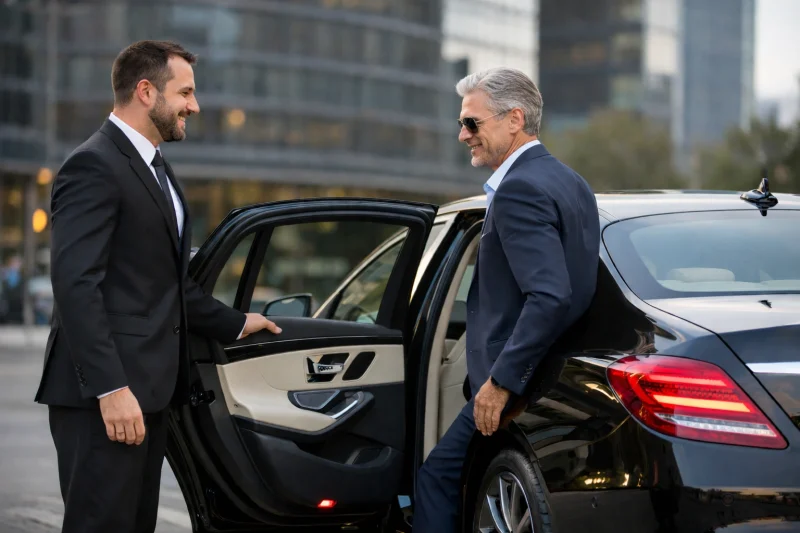
This is the baseline for executive ground travel. It involves professional drivers who are often employees of a specialized firm rather than a general ride-share platform. The primary advantage is the “vetted” nature of the operator and the consistency of the vehicle.
2. Private Aviation (Fractional vs. Charter)
For regional or international travel, private aviation remains the gold standard. Fractional ownership offers more control and availability, while chartering provides flexibility without the long-term capital expenditure.
3. Specialized Armored Transport
Necessary in high-risk jurisdictions or for high-profile public figures. These vehicles are indistinguishable from standard SUVs to the untrained eye but feature reinforced passenger cells and run-flat tires.
4. Executive Rail (Regional Focus)
In Europe and parts of Asia, high-speed rail with private “conference” compartments is often more efficient than flying for city-to-city travel, offering stable connectivity and more space than an aircraft cabin.
5. Corporate Shuttles (Group Mobility)
When moving a leadership team or a board, specialized luxury motor coaches or sprinters allow for collaborative work en route, turning travel time into a productive meeting session.
6. Personal Security Detachments (PSD)
While not a vehicle type itself, PSDs are often integrated into transportation. The driver is a trained protection officer capable of evasive maneuvers and trauma response.
7. Helicopter Charters (Urban Bypass)
Used primarily for bypassing extreme urban congestion (e.g., JFK to Manhattan or São Paulo city center). This is the ultimate “time-save” option for short distances.
Comparison of Core Mobility Modes
| Feature | Private Aviation | Armored Ground | Professional Chauffeur | High-Speed Rail (First) |
| Speed | Extreme (Long Dist) | Moderate (Local) | Moderate (Local) | High (Regional) |
| Security | Very High | Maximum | Moderate | Low to Moderate |
| Privacy | Absolute | High | High | Low |
| Connectivity | Variable/Satellite | High | High | High |
| Cost Basis | High Hourly/CapEx | Mid-High Daily | Mid-Range Hourly | Low-Mid Per Trip |
Realistic Decision Logic
The selection of top executive transportation options is rarely about preference; it is about the “Mission Profile.” A trip to a stable financial hub requires a different logic than a site visit to a remote mining operation.
-
Rule of Proximity: If the destination is under 300 miles and involves multiple stops, ground transport is usually superior for continuity.
-
The Exposure Variable: If the executive is a household name, the “anonymity” of a standard black SUV often provides better security than a flashy exotic car.
Detailed Real-World Scenarios Top Executive Transportation Options
Scenario A: The Multi-City “Roadshow”
An IPO roadshow involves four cities in three days. The failure mode here is “cumulative delay.” A single commercial flight cancellation Cascades through the entire schedule.
-
Solution: Private aviation combined with “Greeter” services at each FBO (Fixed Base Operator) to ensure the car is on the tarmac the moment the plane touches down.
Scenario B: Emerging Market Site Visit
An executive needs to visit a production facility in a region with high kidnapping rates.
-
Failure Mode: “Pattern of Life” predictability. Using the same car every day makes the executive a target.
-
Solution: Armored vehicles with varying routes and “lead/follow” cars to manage perimeter security.
Scenario C: The Urban Mega-Event
Traveling to a global summit (like Davos or the UN General Assembly). Traffic is gridlocked, and security cordons are everywhere.
-
Solution: E-bikes or specialized walking details for the “last mile,” as traditional top executive transportation options may be rendered useless by congestion.
Planning, Cost, and Resource Dynamics
The financial burden of these services is often misunderstood as being purely about the rental fee. The true cost includes the “standby” time and the insurance premiums.
Cost Ranges (Estimated)
| Service Type | Typical Pricing Unit | Range (USD) | Factors Affecting Cost |
| Chauffeur (Sedan) | Hourly (Min 3-4hrs) | $85 – $250 | Vehicle class, City, Peak time |
| Armored SUV | Daily Rate | $1,500 – $4,500 | Armor level (B4-B7), Driver skill |
| Light Jet Charter | Per Flight Hour | $3,500 – $7,000 | Fuel surcharges, Landing fees |
| Executive Coach | Daily Rate | $1,200 – $3,000 | Amenities, Distance traveled |
Opportunity Cost Analysis: If a CEO earns $10 million annually, their time is worth roughly $80 per minute. A two-hour delay at a commercial airport security line effectively costs the company $9,600 in lost leadership time—often more than the cost of a private charter.
Tools, Strategies, and Support Systems
The execution of high-level transport relies on a “back-of-house” infrastructure that the executive rarely sees.
-
Travel Management Companies (TMCs): Specialized firms that handle the booking and vetting of global vendors.
-
Global Security Operations Centers (GSOCs): 24/7 hubs that monitor the vehicle’s GPS position and local threat levels.
-
Encrypted Communication Suites: In-car Wi-Fi that utilizes VPNs and hardware-level encryption to prevent data interception.
-
Flight Tracking & Manifest Management: Software that alerts ground teams of early arrivals or weather diversions in real-time.
-
Vetting Protocols: Background checks for drivers that go beyond standard criminal records to include behavioral assessments.
-
Medical Support: Integration of AEDs (Automated External Defibrillators) and trauma kits within the vehicle, with drivers trained in first aid.
Risk Landscape and Failure Modes
The primary risk in selecting top executive transportation options is the “single point of failure.”
-
Technological Reliance: An executive relying on a “smart” car may be stranded if the software glitches or the cellular network for the GPS fails in a remote area.
-
Driver Fatigue: In long-haul ground transport, the driver’s physical state is often the weakest link.
-
The “Celebrity” Paradox: Using a highly visible motorcade can draw more negative attention than it prevents, creating a target where none existed.
-
Compounding Risks: A delayed flight leads to a rushed driver, which increases the probability of a traffic accident—the most common physical threat to executives globally.
Governance, Maintenance, and Long-Term Adaptation
Organizations must treat transportation as a governed process, not an ad-hoc perk. This involves a regular review of travel policies and vendor performance.
The Quarterly Mobility Audit
A structured review should address:
-
Vendor Compliance: Are the vehicles being maintained to the manufacturer’s standards?
-
Incident Logs: Were there any “near misses” or delays?
-
Cybersecurity Health: Have the in-car routers had their firmware updated?
Adaptation Triggers
What causes a change in the transportation profile?
-
Political Instability: A change in the local government of a manufacturing hub.
-
Executive Profile Change: A promotion that brings significantly more media or activist attention.
-
Health Requirements: The onset of a physical condition that makes certain modes of travel (like small helicopters) non-viable.
Measurement, Tracking, and Evaluation
How do you measure the “ROI” of a $5,000 jet charter or a $200-an-hour driver?
-
Leading Indicators: Driver training certifications, vehicle age, and pre-trip briefing completion rates.
-
Lagging Indicators: Total minutes of delay per year, security incidents per 1,000 miles, and “Work-Production Hours” (how many hours the executive actually worked while in transit).
-
Qualitative Feedback: Bi-annual interviews with the executive and their administrative assistants to identify “friction points” that data might miss.
Common Misconceptions and Oversimplifications
-
“Newer is always better.” A two-year-old vehicle with a highly experienced driver is safer than a brand-new car with a novice driver.
-
“Electric vehicles are always the best green option.” In some regions, the charging infrastructure is so unreliable that it introduces significant “mission risk.”
-
“Ride-share premium apps are executive-grade.” These services lack the vetting, insurance depth, and duty-of-care guarantees required for corporate governance.
-
“Privacy glass equals security.” Tinted windows do nothing to stop a projectile or a determined tracker; they are a comfort feature, not a defense.
-
“Direct flights are always faster.” Sometimes a private leg to a smaller regional airport (closer to the final destination) saves hours of ground traffic compared to a major hub.
-
“The executive chooses the car.” In a well-run organization, the security and logistics teams choose the car based on the threat and mission profile; the executive’s preference is secondary to safety.
Ethical and Contextual Considerations
The use of top executive transportation options often faces scrutiny regarding environmental impact. The carbon footprint of private aviation, in particular, is a point of contention. To address this, many organizations are moving toward “Sustainable Aviation Fuel” (SAF) and carbon-offset programs.
There is also the “Optics vs. Utility” debate. In times of corporate downsizing, a fleet of high-end sedans can damage employee morale. Strategic leaders balance the functional necessity of secure transport with the public and internal perception of the company’s spending.
Conclusion
The selection and management of top executive transportation options is a discipline of nuance. It is the art of balancing the tangible (speed, cost, safety) with the intangible (privacy, mental clarity, and readiness). As the global environment becomes increasingly volatile—both physically and digitally—the systems that move our leaders must become more resilient and more integrated. The goal is not to provide a luxury experience, but to ensure that when a leader arrives at their destination, they are prepared to perform at the highest possible level. Effective mobility is the silent engine of executive performance.